


The average restaurant runs 80 to 200 recurring daily tasks across front-of-house, back-of-house, and management. Temperature checks, station setup, opening procedures, mid-shift cleaning, food rotation, cash reconciliation, equipment shutdown. Most of these happen every single day, on every shift, whether or not anyone is actually keeping track.
When tasks get missed in a high-turnover environment, the consequences add up quickly. A temperature log that nobody completed is a health inspection finding. A closing task that got skipped becomes the morning crew’s problem. A compliance check that slipped through is a liability waiting to surface. And in a restaurant with 40% annual staff turnover, the knowledge that keeps things running walks out the door with every person who leaves.
This guide is for restaurant owners, general managers, multi-unit operators, and franchise ops teams who want to move beyond informal task tracking to a system that holds up at scale.
What Is Restaurant Task Management?
Restaurant task management is the system for creating, assigning, tracking, and verifying all operational tasks across FOH, BOH, and management, whether you run one location or twenty.
That is different from a generic project management tool, which is built for one-off projects with long timelines. Restauranttask management is built for a completely different reality: tasks that repeat every shift, that are time-sensitive, that tie into compliance requirements, and that need someone other than the person who did them to verify they were actually done.
A line cook does not need a project management app to know when to check the walk-in temperature. They need something that tells them exactly what to do, at what time, and lets a shift leader confirm it happened.
Paper checklists, whiteboards, and verbal handoffs can hold things together in a single location with a stable, experienced team. But they fall apart when staff turns over, when you open more locations, or when a health inspector asks to see documentation. Paper can be filled in after the fact. Whiteboards get erased. Verbal instructions cannot be tracked. And none of them give a multi-unit operator any visibility into what is happening at a location unless they are physically there.
Types of Restaurant Tasks
Not all restaurant tasks are the same, and treating them like they are is one of the main reasons task management breaks down. There are four distinct types, each with its own timing, ownership, and risk if missed.
Recurring Daily Tasks
These are the tasks that make up the daily rhythm of the restaurant. Opening procedures, closing procedures, mid-shift cleaning, temperature checks, FIFO rotation, station prep, restroom checks, cash drawer setup. They happen every day, on every shift, and they are the baseline for consistent operations.
Most task management programmes focus here and stop. These tasks matter, but they are only one piece of the picture.
Compliance-Triggered Tasks
These are tasks that come from regulatory schedules, not shift rhythms. FDA Food Code compliance checks, OSHA safety verifications, health department pre-inspection prep, food handler certification renewals, and HACCP log reviews all fall here.
Compliance-triggered tasks do not follow the daily opening and closing flow. They happen weekly, monthly, quarterly, or when a regulatory deadline is approaching. Because they sit outside the normal shift routine, they are the tasks most likely to be forgotten. They also carry the most serious consequences when they are missed. In practice, these are the items that show up as health inspection findings when nobody thought to put them on anyone’s radar.
Event-Based Tasks
Event-based tasks are triggered by specific situations : a new menu rollout, an upcoming health inspection, an equipment maintenance flag, a seasonal menu change, or a new hire who needs onboarding. They are not recurring and they are not compliance-driven. They are just things that need to happen because of a specific circumstance.
The tricky part is that someone has to create and assign these in real time rather than pulling from a standing template. Without a system, they tend to get handled through verbal instructions or a last-minute message, and they often get missed entirely.
Escalation Tasks
Escalation tasks are what should happen when a primary task is missed or flagged as incomplete. Who gets notified? By when? What do they need to do?
Most restaurants have no formal answer to those questions. A missed temperature check either goes unnoticed until the next retail audit or causes a last-minute scramble. A proper escalation workflow makes the process automatic: if a task is not done by a set time, the shift leader gets a notification. If it is still open after another window, it goes to the area manager. The task stays visible until someone closes it out.
Without that, missed tasks are invisible until they cause a real problem.

Role-Based Task Assignment Framework
The most common reason restaurant task management fails is not that the task list is wrong. It is that nobody is clearly responsible for anything. Tasks that belong to everyone get done by no one. Every task needs a named role, not just a named person, so ownership does not disappear every time someone leaves.
Here is how that works across the typical restaurant structure.
General Manager and Area Manager
At the GM and area manager level, task management is mostly about visibility and oversight, not hands-on execution. Tasks here include reviewing audit completions, confirming scheduling coverage, verifying vendor deliveries against purchase orders, reviewing compliance records, and signing off on weekly inventory counts.
GMs and area managers need to see across all task categories, including the ones being handled by crew and shift leaders. Their interface is a dashboard, not a checklist. They need to see at a glance what is done, what is overdue, and where escalations are sitting.
Shift Leader and Supervisor
Shift leaders are at the most operationally critical point in the ownership structure. They are responsible for delegating opening and closing tasks to crew, verifying that crew tasks were completed correctly, handling mid-shift compliance checks, and managing escalations when something gets flagged or missed.
A shift leader who starts their shift without knowing what the previous crew did or did not finish is walking into the shift blind. Giving shift leaders real-time task visibility is what stops those blind spots from turning into operational failures.
Line Staff and Crew
At the crew level, the system needs to be as simple as possible. Execution tasks like station prep, cleaning, restocking, and temperature checks need to be clear, specific, and easy to complete on a phone. Pass or fail completion with optional photo evidence is usually the right format. Long instructions or complicated interfaces will not get used consistently by hourly staff in the middle of a busy shift.
If a crew member has to ask their manager what a task means, the task is not written clearly enough.
Multi-Location and Franchise Layer
For multi-unit operators and franchise groups, task management adds a layer that most guides never address. Corporate or franchisor teams need to push standardised task templates down to every location. Individual locations should be able to adjust timing and sequence without being able to change the core requirements.
Area managers need deviation reporting : which locations completed everything, which had missed tasks, and which have recurring gaps that point to a systemic training or accountability problem. Without centralised task management, each location quietly develops its own version of the operating procedures. A franchise in Phoenix builds different habits from one in Atlanta, and neither ends up doing exactly what HQ intended.
Building a Restaurant Task List That Works
A well-structured restaurant checklist is organised across four dimensions: time of day, location in the restaurant (FOH, BOH, or management), frequency (daily, weekly, monthly), and role owner. When any of those four is missing, tasks get missed.
Opening Task List Structure
Opening tasks set the conditions for the whole shift. A complete opening task list covers equipment checks and temperature log starts , FOH and BOH station prep, cash drawer setup and POS verification, a safety walkthrough covering emergency exits and aisle clearance, and FOH setup including tables, menus, and cleanliness.
These tasks should be assigned to specific roles, sequenced in the right order, and confirmed complete before the first customer walks in.
Mid-Shift Task List Structure
Mid-shift tasks keep up the standards that opening sets. That means temperature log mid-point checks, restocking when supplies drop below a threshold, surface cleaning on schedule, and food rotation checks for anything that has been out since opening. These are the tasks that are easiest to skip during a busy service period , which is exactly when they matter most.
Closing Task List Structure
Closing tasks protects the next shift. Equipment shutdown in the right order, food storage and labelling for anything going into the walk-in, cleaning and sanitising all surfaces and equipment, cash reconciliation, and a security walkthrough before the last person leaves. Closing tasks that get rushed or skipped become opening problems for whoever arrives at 6am.
Weekly and Periodic Tasks
Beyond daily tasks, a complete task list includes weekly and periodic items: deep cleaning, scheduled maintenance checks, inventory audit, and verification of staff training records and food handler certifications. These are less visible than daily operations but carry real compliance and operational weight. They should be assigned, tracked, and verified the same way daily tasks are, not left to memory.
Common Failures in Restaurant Task Management
Most restaurant task management problems are predictable. Here are the five that come up most often, and what to do about each.
Verbal-Only Instructions
When tasks live in a manager’s head and get passed along verbally at the start of a shift, there is no record, no consistency, and no way to check what actually happened. Instructions get misheard, forgotten, or interpreted differently by different people. Any task that repeats needs to be written down, assigned by role, and tracked, so it does not depend on anyone remembering to say it.
No Ownership Assignment
Tasks posted on a whiteboard with no names attached tend to get done by the most conscientious person on shift, or not done at all. Role-based assignment means every task has a clear owner before the shift starts. When something is not done, it is immediately obvious who was responsible.
No Escalation Path
Without an escalation workflow, missed tasks go unnoticed until they cause a problem: a health inspection finding, a food safety issue, a complaint from the morning crew. A proper escalation path means a missed task becomes visible within a set window, goes to the shift leader, and if it is still open, goes to the area manager. It stays on record until it is resolved.
Multi-Location Drift
In a multi-location operation without centralised task management, each restaurant gradually builds its own version of the operating procedures. Some locations skip tasks others treat as non-negotiable. By the time anyone notices, the divergence is significant. A central task template that pushes to all locations keeps standards consistent and makes gaps visible.
No Completion Verification
Paper checklists can be ticked off without the task being done. Anyone who has managed a restaurant knows this happens. Digital task management with photo verification and timestamped completion creates a record of what actually happened, not just what someone wrote down. That record also becomes useful documentation if a health inspector comes calling.
Measuring Restaurant Task Management Performance
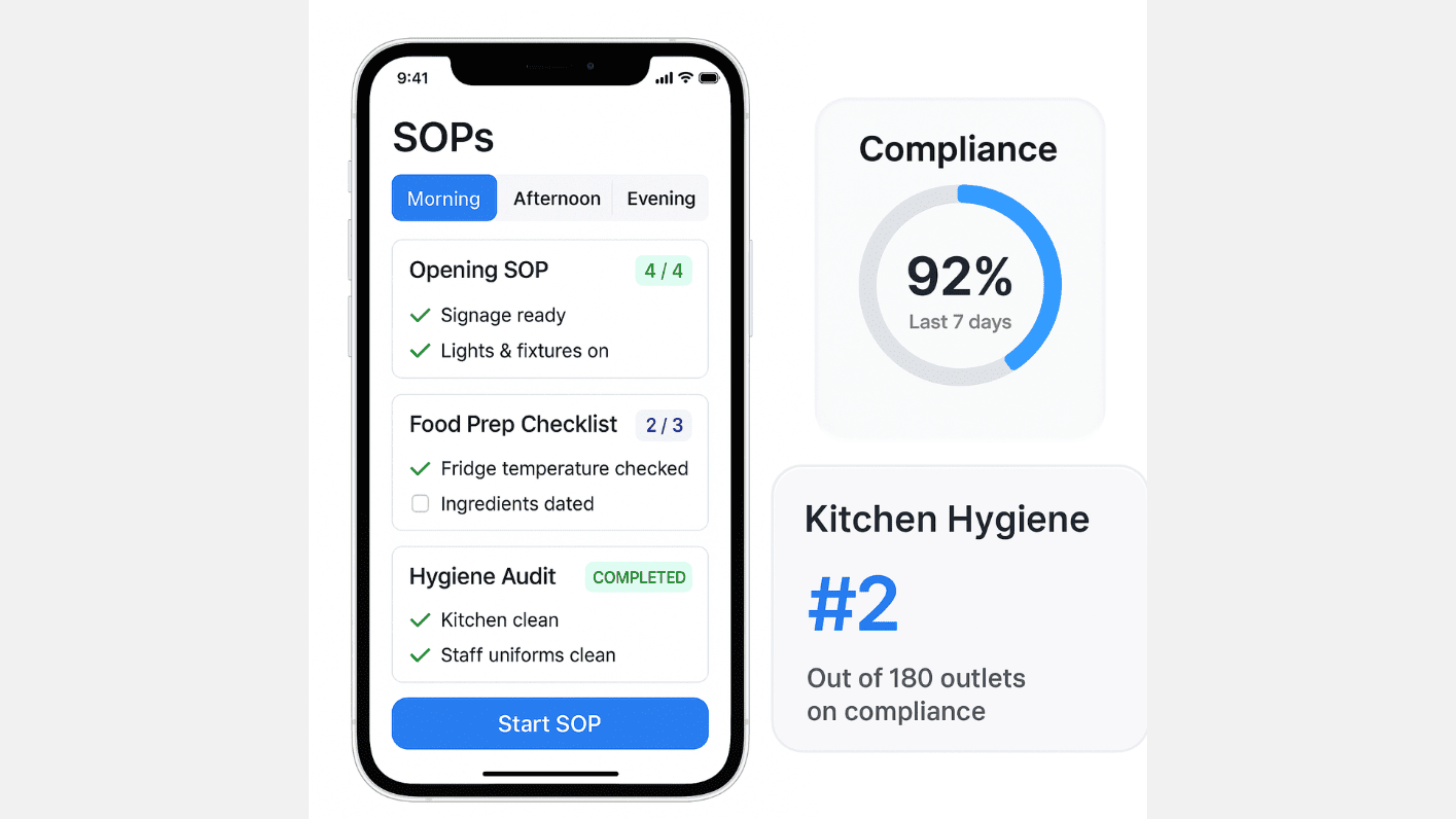
If your task management system is capturing data, you should be using it. Here are the key metrics that tell you whether the programme is actually working.
Task completion rate by shift, location, and role. The overall number matters, but the breakdown matters more. A 95% completion rate that hides one location running at 70% is not a healthy programme.
Average task completion time versus target. If temperature checks are supposed to happen at 10am and are consistently being done at noon, either the schedule is wrong or the assignment is not working. Completion time data surfaces those gaps.
Missed-task rate and escalation frequency. How often are tasks not completed within the required window? A high escalation rate is not always a bad sign. It can mean the escalation workflow is catching things it is supposed to catch. What matters is whether escalations are being resolved, and how quickly.
Compliance task pass rate. Track compliance-triggered tasks separately from daily operational tasks. A high operational completion rate paired with a lower compliance task rate is a specific risk profile, and a leading indicator of how a health inspection is likely to go.
Cross-location completion benchmarking. For multi-unit operators, comparing completion rates across locations is one of the most useful things a task management system makes possible. It shows which locations are consistently strong, which need attention, and whether there are patterns at the area manager level worth looking at.
Task completion data is also training data. If the same task category keeps failing at the same location or in the same role group, that is a training problem, not an individual performance issue. The distinction matters for how you respond to it.
Conclusion
Restaurant task management is what connects every shift, every role, and every location in your operation. When it works, things run consistently no matter who is on that day or how long they have been with the company. When it does not, every shift relies on whoever happens to be in the building knowing what needs to get done.
Moving from informal task tracking to a proper system does not require a big overhaul. It requires clear ownership, a consistent task list, a way to verify what was done, and an escalation path for when things go wrong.
If you are ready to build that across your locations, Amply – Task Management Software has what you need: role-based task management, real-time tracking, photo verification, and multi-location reporting built for restaurant operators.
Book a meet to see how Amply works →
Frequently Asked Questions
What is restaurant task management?
A system for creating, assigning, tracking, and verifying tasks across FOH, BOH, compliance, and management. Unlike a checklist, it includes real time tracking, role based ownership, escalation workflows, and performance reporting.
What should be on a restaurant task list?
Opening and closing procedures, food prep and temperature checks, cleaning and sanitation, compliance checks, inventory counts, equipment maintenance, and staff training. Tasks should be organized by role, time, and frequency.
How is it different from a checklist?
A checklist is static. Task management is a complete system with task assignment, real time tracking, escalation of missed tasks, and reporting. A checklist is just one part of it.
What is the best restaurant task management app?
It depends on your size and needs. Key features include role based assignment, photo verification, offline access, automated escalations, and multi location dashboards. Amply is designed for restaurant operators and franchise groups.
How do I standardize task management across locations?
Use a central platform with master templates shared across locations. Track performance from one dashboard. Deviations trigger escalations automatically while allowing minor local adjustments.


