


Here’s something worth thinking about: McKinsey research shows retailers that optimize store operations can achieve up to 30% higher profitability. That’s not a small margin improvement. That’s a business transformation.
And yet, for most US retailers, store operations still get treated as a back-office concern, something the store manager handles while leadership focuses on merchandising strategy, marketing campaigns, or the next store opening. That’s a costly gap.
This guide covers everything you need to understand about retail store operations : what it actually means, the 10 core components that make it up, who owns what across the org chart, the US compliance context you can’t afford to ignore, the KPIs worth tracking, how multi-location and franchise operations add complexity, and the practical steps to improve performance across all of it.
Whether you’re running a single location or a multi-unit chain, this is the operational foundation your business runs on.
What Are Store Operations? Definition
Store operations refers to the complete set of activities, processes, roles, and systems involved in running a retail store. That covers everything from receiving product at the back door to the moment a customer completes checkout, and every process that enables or supports that journey in between.
It includes inventory management, staff scheduling, visual merchandising, customer service delivery, compliance checks, loss prevention, payment processing, and increasingly, fulfilling orders that were placed online. In short, if it happens in or because of a physical retail location, it falls under store operations.
One distinction worth making clear: store operations is not the same thing as retail management, even though the terms often get used interchangeably. Operations is the execution layer. It’s the daily, weekly, and shift-level work of keeping the store running to standard. Management is the strategic layer, responsible for setting direction, making resource decisions, and building the systems that operations run on. Both matter. But you can have a clear retail strategy and still fail at execution, which is where most retailers actually lose money.
This definition applies across the board: single-location independent retailers, multi-unit specialty chains, franchise systems, and omnichannel retailers running both physical stores and digital channels. The scope expands with complexity, but the fundamentals stay the same.

10 Core Components of Retail Operations
Retail operations isn’t one thing, it’s a collection of interdependent functions that have to work together for a store to perform well. Here are the 10 core components that make up the full picture.
Inventory Management
This is tracking what you have, forecasting what you’ll need, ordering to replenish it, and managing returns when product comes back. Inventory management sits at the center of almost every other operational function; it affects what you can sell, how you staff, what you promote, and how accurately you can fulfill online orders.
According to the National Retail Federation, the average US retailer loses around 1.6% of revenue to shrinkage annually. That’s a benchmark worth knowing, because it tells you what “normal” looks like, and that normal has significant room for improvement.
Real-time inventory visibility is no longer optional for retailers operating any kind of digital channel. If your stock data is off by even a small margin, you’re either promising customers products you don’t have or turning away sales because your system says you’re out of something you’re not.
Visual Merchandising and Store Layout
Planogram execution, window displays, in-store signage, product placement; all of this shapes how customers move through the store and what they buy. Visual merchandising isn’t just about aesthetics. It’s a performance lever.
Getting this right requires consistent execution across every location and every reset cycle. A planogram that looks great in headquarters’ presentation but gets executed inconsistently across 50 stores is a missed revenue opportunity at scale.
Customer Service
Customer service in a retail context covers every touchpoint: how staff greet customers when they enter, how they handle questions on the floor, how returns get processed, and how complaints get resolved. These interactions are where the brand either earns loyalty or loses it.
Service standards need to be trained, not assumed. And they need to be reinforced consistently, which is an operational responsibility, not just a cultural one.
Staff and Workforce Management
Retail Staff Hiring, onboarding, scheduling, training, and performance management all fall here. For US retailers, workforce management carries significant compliance weight. The Fair Labor Standards Act (FLSA) governs minimum wage and overtime requirements. State-level break laws add another layer of complexity depending on where your stores operate.
Labor cost typically represents one of the largest expense lines in retail. Managing it well means scheduling to demand without cutting into service quality and documenting everything for compliance purposes.
Supply Chain and Receiving
Vendor management, purchase order creation, shipment receiving, and transfers between stores or warehouses all sit under supply chain and receiving. For US retailers, this function has gotten harder. Tariff exposure, carrier reliability issues, and supplier compliance requirements have all added complexity to what used to be a more predictable function.
Receiving accuracy matters more than it often gets credit for. Bad receiving data is inventory data and inventory data errors cascade downstream into every other part of the operation.
Promotions and Pricing
Executing campaigns, managing markdowns, and maintaining pricing accuracy are all operational responsibilities, not just marketing ones. The FTC has clear guidelines around pricing accuracy, and state-level consumer protection laws add requirements around how promotional pricing gets communicated and applied.
Pricing errors at the shelf aren’t just a customer experience problem. They’re a compliance risk.
Payments and Order Processing
POS system management , handling all payment types, and increasingly, managing buy-now-pay-later (BNPL) options at checkout. In the US, Payment Card Industry Data Security Standard (PCI DSS) compliance is mandatory for any retailer accepting card payments, which is essentially every retailer.
For omnichannel operations, this component also includes processing and fulfilling buy online pick up in store (BOPIS) orders at the point of sale.
Store Safety and Loss Prevention
OSHA compliance, ADA accessibility , physical hazard management (wet floors, clear aisles, emergency exits), and loss prevention strategy all belong here. The NRF has reported that retail shrink costs the US industry over $100 billion annually, which is why loss prevention has become a dedicated function in most mid-to-large retail organizations rather than an afterthought.
Safety and loss prevention overlap more than people realize. A well-maintained, well-lit, organized store is harder to steal from and safer for both customers and employees.
Store Compliance and Auditing
Brand standard adherence, regulatory compliance checks, health and safety inspections, and operational audits are the mechanisms that tell you whether the other nine components are actually being executed the way they’re supposed to be.
Digital audit tools like Amply ’s Task Management tool have largely replaced paper checklists in multi-location retail because they create accountability, documentation, and real-time visibility that paper simply can’t provide.
Omnichannel Operations
This is the component most commonly missing from traditional store operations frameworks and it’s now standard for US retail chains. Online pick up in store, curbside pickup, ship-from-store fulfillment, and same-day delivery coordination all require physical store teams to execute digital orders accurately and on time.
Getting omnichannel right requires inventory accuracy at the store level, clear fulfillment SOPs, and SLA management, because a failed BOPIS order doesn’t just lose a sale, it damages trust in both the digital and physical channel simultaneously.
Retail Store Operations Roles and Responsibilities
Store operations don’t run on processes alone—they run on people who own specific parts of those processes. Here’s how accountability typically breaks down across the org hierarchy.
| Role | Key Responsibilities | Owns |
|---|---|---|
| District / Area Manager | Multi-store compliance, budget oversight, performance review, escalation decisions | Store network KPIs |
| Store Manager | P&L ownership, staff management, compliance, inventory, customer experience | Store-level performance |
| Assistant Store Manager | Shift operations, team supervision, opening/closing, training execution | Shift performance |
| Department Supervisor | Department inventory, planogram execution, department staff scheduling | Department compliance |
| Loss Prevention | Shrink reduction, CCTV monitoring, exception-based reporting, incident response | Shrinkage rate |
| Store Associate | Customer service, replenishment, checkout, BOPIS fulfillment, display maintenance | Task completion rate |
One thing this table makes clear: store operations ownership isn’t siloed at the store manager level. Every role in the store has operational accountability for something. When organizations treat operations as purely a store manager concern, they lose the distributed ownership that makes consistent execution possible.
US Compliance Context for Retail Store Operations
Compliance is one of the most underestimated components of store operations and one of the most consequential when it goes wrong.
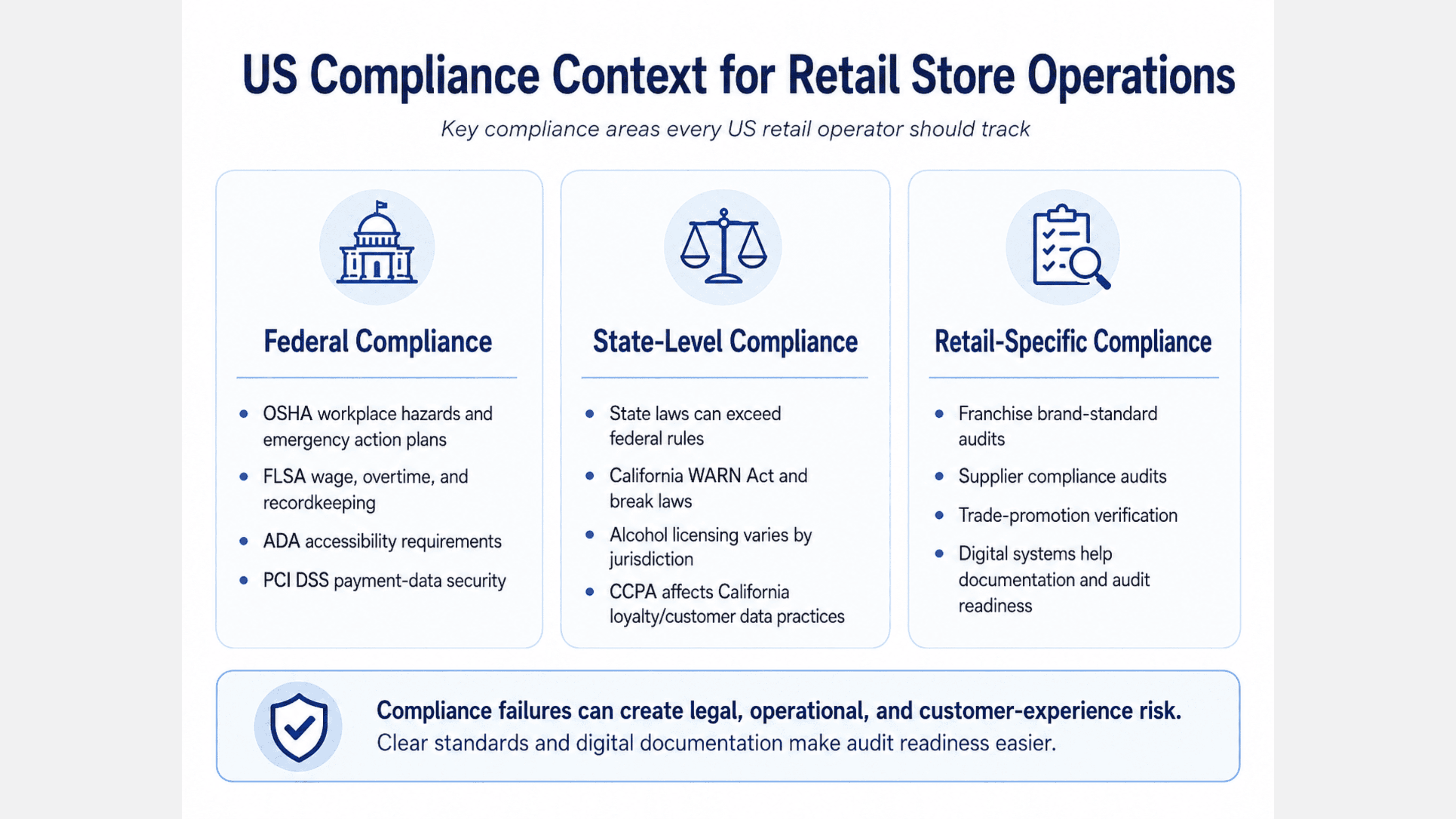
Federal Compliance
OSHA requires retailers to manage general duty clause obligations, which means identifying and addressing workplace hazards before they cause injuries. Slip, trip, and fall hazards are among the most common sources of OSHA violations in retail. Every store also needs an emergency action plan.
FLSA governs federal minimum wage, overtime pay, and recordkeeping requirements. State laws frequently add stricter requirements on top of federal standards, so compliance can’t be managed at just the federal level.
ADA sets accessibility standards for store layout, signage, fitting rooms, and checkout areas. Non-compliance isn’t just a legal risk, it’s a barrier to serving customers with disabilities.
PCI DSS is mandatory for every US retailer that accepts card payments. Requirements cover data security, system access controls, and regular compliance validation.
State-Level Compliance
California’s WARN Act applies to multi-location retailers making significant staffing changes. State-specific break law requirements vary significantly. What’s compliant in Texas may not be compliant in California or New York.
Retailers that sell alcohol need state-level licensing that varies by jurisdiction. And California retailers collecting customer loyalty data need to understand CCPA requirements around how that data is collected, stored, and used.
Retail-Specific Compliance
Franchise systems operate under brand standard audit requirements set by the franchisor. Suppliers increasingly require compliance audits as a condition of the commercial relationship. Trade promotion agreements come with their own verification requirements.
Each of these adds layers of compliance work that store teams need to be prepared for, ideally with digital systems that make documentation and audit readiness easier to maintain.
Retail Store Operations KPIs
If you’re not measuring it, you can’t manage it. Here are the core metrics for retail store efficiency, along with US benchmarks where they exist.
| KPI | Formula / Definition | US Benchmark |
|---|---|---|
| Conversion Rate | Transactions divided by store traffic | Varies by format; track trend vs. prior period |
| Average Transaction Value (ATV) | Revenue divided by number of transactions | Category-dependent; track vs. prior period |
| Units Per Transaction (UPT) | Units sold divided by transactions | Track vs. prior period and category average |
| Gross Margin Return on Investment (GMROI) | Gross Margin dollars divided by average inventory cost | Higher is better; track trend direction |
| Shrinkage Rate | Inventory loss divided by total sales | Target below 1.5% (NRF benchmark: 1.6%) |
| Labor Cost as % of Revenue | Labor cost divided by revenue | Track against your format’s historical baseline |
| Task Completion Rate | Tasks completed on time divided by total assigned tasks | Track toward consistent high completion |
| Net Promoter Score (NPS) | Customer loyalty metric | Track trend and compare to prior periods |
A few notes on using this table well. KPIs without a universal benchmark aren’t less important, they just require you to establish your own baseline and track movement over time. Conversion rate and ATV vary so much by retail format and category that industry averages are less useful than your own store’s historical trend.
The KPIs that do have widely-referenced benchmarks, like shrinkage rate, give you a useful external reference point. If your shrinkage is significantly above the NRF benchmark, that’s a signal worth investigating regardless of what your trend line looks like.
Multi-location and Franchise Store Operations
Running one store well is hard. Running 10, 50, or 500 consistently is a different challenge entirely.
The Standardization vs. Flexibility Tension
Corporate sets the non-negotiables: brand standards, compliance requirements, safety protocols, pricing guidelines. These don’t flex by location. But individual stores need room to adapt in other areas. Staffing schedules that reflect local traffic patterns, community engagement that fits the local market, promotional emphasis that responds to regional customer behavior.
Defining clearly which decisions are centralized and which are delegated is one of the most important operational design choices a multi-location retailer makes. When this isn’t clear, you get either over-rigidity (store managers disengaged because they have no authority) or inconsistency (every store doing things differently in ways that undermine the brand).
The Area Manager as the Operational Linchpin
Once a retail organization crosses five or more locations, the area or district manager becomes the primary mechanism for operational consistency. They’re the connection between corporate standards and store-level execution.
As location counts grow, in-person visits alone can’t provide sufficient visibility. Area managers increasingly rely on digital dashboards, audit scores, and task completion data to know what’s happening across their portfolio between visits.
Technology Requirements for Multi-Location
The technology stack for multi-location retail operations needs to include: a centralized task management platform, a real-time compliance dashboard, a standardized digital audit tool, unified inventory visibility, and either a single POS ecosystem or a well-integrated layer connecting multiple systems.
These aren’t nice-to-haves at scale. They’re the infrastructure that makes perfect store execution possible without requiring a manager physically present in every store every day.
Franchise-Specific Operations Requirements
Franchise systems add another layer of operational complexity. Franchisees operate under brand standard audit schedules set by the franchisor. Royalty reporting, franchise agreement operational mandates, and franchisor SLA compliance all create operational requirements on top of the standard retail stack.
Franchisors need visibility into franchisee compliance without running the day-to-day operations of each location. Digital audit and task management tools make this visibility possible at scale.
How to Improve Retail Store Operations
Knowing what store operations involve is one thing. Actually improving it is another. Here are the highest-impact areas to focus on.
Digitize Task and Checklist Management
Paper checklists create accountability gaps. They can be completed on paper without the task actually being done, they’re hard to review in real time, and they produce no useful data over time.
Digital task management platforms assign every shift task to a specific role, timestamp completion, and in many cases require photo verification. Area managers get a real-time dashboard showing completion rates across all their locations. When a store is consistently failing to complete opening procedures on time, you see it in the data, you don’t have to discover it during a visit.
Implement a KPI Dashboard
Pick five to eight KPIs from the framework above and commit to tracking them consistently. Weekly at the store level, monthly at the district level. Tie KPI outcomes to manager performance review cycles so there’s a clear connection between what gets measured and what gets recognized or addressed.
A dashboard that nobody looks at or acts on isn’t a KPI system. The cadence and the accountability structure matter as much as the metrics themselves.
Standardize SOPs Across Locations
Every repeating process: opening procedures, receiving, planogram resets, BOPIS fulfillment, closing routines should be documented as a Standard Operating Procedure. SOPs should be version-controlled centrally and updated digitally, not distributed via email where old versions live on people’s desktops indefinitely.
Use Amply ’s SOP Builder to standardize your SOPs across stores.
Invest in Staff Training Compliance
Training compliance isn’t just about knowledge transfer. In US retail, it’s a legal and operational requirement. FLSA-mandated training, state-law break requirements, product and brand training, loss prevention awareness, and customer service standards all need to be tracked as operational KPIs and not assumed to be happening because onboarding happened once six months ago.
Training completion rates are one of the most overlooked leading indicators of operational performance. Stores with consistent training compliance tend to have lower shrink, better customer satisfaction scores, and fewer compliance violations.
Build an Omnichannel Operations Capability
If your stores are fulfilling BOPIS or ship-from-store orders, those functions need the same operational rigor as in-store service. That means a clear fulfillment SLA, picking accuracy standards, inventory accuracy at the store level so online availability signals are reliable, and a curbside pickup process that’s consistent across locations.
Omnichannel operations that are bolted on as an afterthought create customer experience problems that damage both digital and physical channel trust. Building it as a core operational capability with SOPs, KPIs, and training is what separates retailers who execute it well from those who technically offer it but consistently disappoint.
Conduct Regular Store Audits
Scheduled retail audits keep stores prepared. Surprise audits tell you what’s actually happening. Both are useful for different reasons.
Digital audit platforms make findings actionable: audit observations get assigned as corrective tasks with an owner and a deadline. Audit scores tracked over time become a KPI that reflects overall operational health. The goal isn’t to catch stores failing, it’s to create a feedback loop that drives continuous improvement.
Conclusion
Retail store operations are the engine behind every customer experience. When they run well, sales grow, staff perform better, and customers return. When they fail, issues appear across shrink, staffing costs, complaints, and compliance.
Operations are also highly improvable. Clear standards, consistent measurement, the right technology, and strong accountability can quickly drive better results.
Ready to bring it all together? Book a demo and see Amply in action.
FAQs
What are store operations?
All activities needed to run a retail store daily, including inventory, staffing, customer service, merchandising, promotions, and payments.
What are store operations in retail?
The execution layer of retail management covering daily tasks like opening, replenishment, scheduling, compliance, service, and closing.
What are the key components?
Inventory, merchandising, customer service, workforce management, supply chain, pricing and promotions, payments, safety, compliance, and omnichannel operations.
What is retail operations management?
The oversight of store functions through standards, KPIs, staffing, compliance, and continuous improvement across locations.
How do you improve store operations?
Digitize tasks, track KPIs, standardize SOPs, invest in training, enable omnichannel, and run regular audits with corrective actions.
What is a store operator?
The person responsible for daily store operations, usually a manager or owner-operator.


