


An unlabeled shelf gap, a promotion that never made it to the end-cap, a price tag that did not update when the campaign went live. Each of these is a small operational failure. Multiplied across hundreds of outlets and dozens of SKUs, they quietly erode sales, damage retailer relationships, and undercut the trade spend that was supposed to drive growth.
Perfect store execution is the discipline that prevents that. It is the operational practice of ensuring every product appears in the right place, at the right price, with the right promotional materials, consistently, across every retail outlet in every territory. Not aspirationally. Not most of the time. Every store, every visit, every cycle.
This guide covers the complete picture: what perfect store execution is and where it came from, the six operational pillars that define it, a six-stage framework for running it in practice, role-based responsibilities across the execution hierarchy, scorecard design with weighted KPIs, channel-specific standards, common failure modes and how to fix them, and a technology maturity model from paper checklists to AI-powered shelf recognition.
What Is Perfect Store Execution?
Perfect store execution is a structured operational standard that ensures every retail outlet reflects the brand’s intended product placement, pricing, promotion, and presentation at the time of every rep visit, every audit, and every shopper interaction.
The concept emerged from field sales organizations in CPG as a way to translate headquarters strategy into measurable in-store reality. Brand teams build planograms, price architectures, promotional calendars, and POSM specifications. The gap between that work and what actually appears on shelf — including the wrong facing count, the missing end-cap display, or the shelf price that did not update when the promotion went live — is exactly what perfect store execution exists to eliminate.
The term is sometimes used loosely to mean “good execution,” but in practice it functions as a defined compliance standard. A store either meets the perfect store criteria for its outlet class or it does not. That binary, compliant or non-compliant, is what makes the whole thing measurable, scalable, and actionable.
For US operators, the framing has a specific commercial edge. Planogram compliance is not just about brand integrity. It is tied directly to the trade agreements that determine shelf space allocation. A brand that consistently underperforms its compliance commitments gives the category manager grounds to reduce facings at the next reset. Perfect store execution, done well, protects those agreements and the sales floor they represent.
At its core, perfect store execution equals store compliance plus shopper experience plus measurable sales lift. Each element reinforces the others. A correctly executed shelf converts more shoppers. A compliant outlet scores better with the retailer. Better scores protect and grow shelf space. More shelf space drives higher sales.
The Six Pillars of Perfect In-Store Execution
Perfect store execution is not a single metric. It is a composite standard built from six distinct operational pillars, each with its own definition, its own measurement method, and its own US benchmark.
On-Shelf Availability (OSA)
On-shelf availability is the percentage of SKUs in the approved planogram that are physically present and shoppable at any given moment. If a product is in the stockroom but not on the shelf, it is not available. It is a lost sale. Top-performing US CPG brands maintain OSA above 97%. Once OSA drops below 95%, lost sales become measurable in weekly scan data, and the gap compounds across high-velocity SKUs and promotional periods when shopper demand spikes.
Planogram Compliance
Planogram compliance measures how closely the actual shelf layout matches the approved planogram for that outlet format. This includes SKU sequencing, facing count, shelf height assignment, and brand block integrity. In US retail, planograms are typically reset on a quarterly or semi-annual basis, making compliance between resets an active field responsibility. Brands that track planogram compliance closely consistently find it to be one of the strongest leading indicators of category sales performance at the outlet level.
Pricing Accuracy
Pricing accuracy means the shelf price matches the POS system price and the active promotional price. In the US, this is not purely an operational concern. FTC regulations and state-level consumer protection statutes create legal exposure when shelf prices differ from scanner prices. A pricing error in a single high-traffic SKU, across hundreds of outlets, can generate regulatory complaints and retailer compliance flags at the same time. Zero tolerance is the only defensible standard.
Promotional Material (POSM) Compliance
Point-of-sale materials — including shelf talkers, end-cap displays, floor graphics, and promotional signage — must be live, correctly positioned, and not expired at the campaign go-live date. This is where US trade promotion ROI is most frequently lost. When POSM is late to stores, installed incorrectly, or still carrying the previous campaign’s creative when the new one launches, the promotional window shrinks and lift suffers. POSM compliance at campaign launch is the single execution KPI most directly tied to promotional lift.
Share of Shelf
Share of shelf measures the brand’s physical shelf space as a percentage of total category space in that outlet. It is tracked against two benchmarks: the trade agreement that defines the brand’s contracted allocation, and the brand’s share of category sales. A brand with 20% category share that holds only 12% of shelf space is under-shelved. Share of shelf is the execution KPI most closely linked to retailer negotiation leverage.
Store Condition and Brand Presentation
Beyond product and pricing, perfect store execution includes the physical condition and visual coherence of the brand’s presence in-store. Dirty fixtures, broken display units, faded signage, and poor lighting directly affect shopper conversion, independently of product assortment. Brand presentation standards are often the last pillar to be formally measured, but they are visible to shoppers before any other execution element.
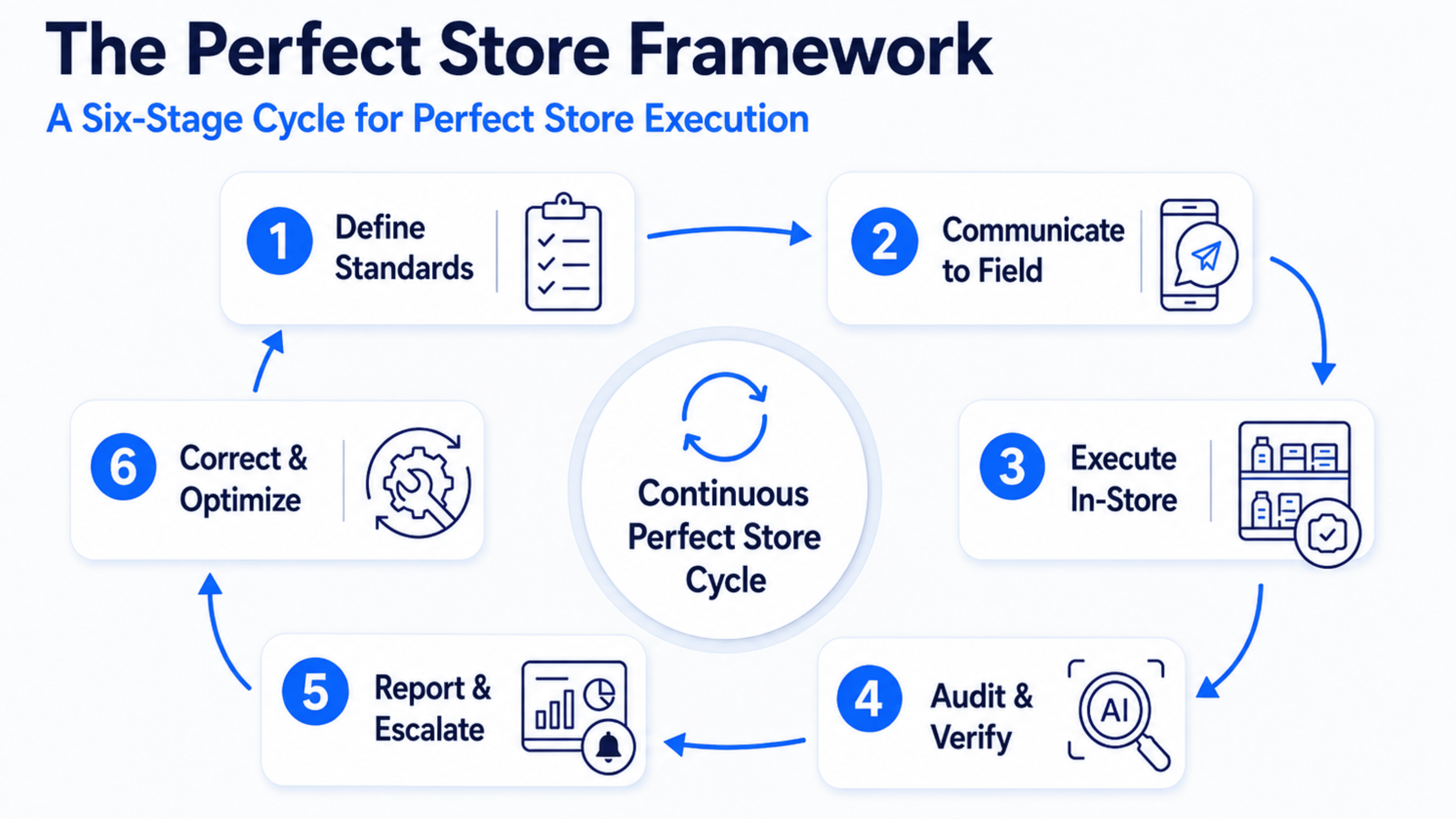
The Perfect Store Strategy & Framework: A Six-Stage Cycle
Perfect store execution is not a project with a start and end date. It is a continuous operational cycle that runs across every territory, every promotional period, and every outlet class. The six stages below form the repeatable process that keeps execution standards live and improving.
Stage 1: Define Standards
Headquarters defines the store standard per outlet type, covering hypermarkets, supermarkets, convenience stores, and general trade. Each channel gets its own planogram, pricing window, promotional calendar, and POSM specification. Standards are not universal.
A convenience outlet with four feet of shelf space executes against a different benchmark than a hypermarket with a full brand block and a dedicated end-cap. Defining these distinctions upfront is what makes field execution measurable rather than subjective.
Stage 2: Communicate to Field
Standards must reach field reps and area managers in a format they can act on, not as PDF attachments buried in an email thread. Mobile-first task platforms push execution standards directly to reps’ devices, with visual references attached — including photos of the correct shelf layout, approved POSM placement examples, and pricing verification checkpoints.
When the standard is visual and accessible in-store, execution quality improves regardless of how long the rep has been in the role.
Stage 3: Execute In-Store
Field reps or retail associates execute tasks per their assigned checklist. Each completed task should be timestamped and photo-verified at the point of completion, not reconstructed after the fact back at the vehicle.
No completion without evidence is the operating rule. A rep who clicks a task complete without submitting a photo provides no useful compliance data. They simply create a false positive in the dashboard.
Stage 4: Audit and Verify
Independent verification of execution quality closes the loop between what was completed and what was actually achieved. This takes three forms depending on scale: area manager spot audits, dedicated third-party field audit teams, or AI image recognition that analyzes shelf photos against the planogram automatically. The audit layer is what separates a real compliance program from a self-reporting system. Without independent verification, completion data reflects what reps say they did, not what was actually on shelf.
Stage 5: Report and Escalate
Real-time dashboard visibility is what converts field data into actionable decisions at brand HQ. Compliance scores should be visible by store, territory, region, and outlet class — not only as aggregate national averages that mask underperforming pockets. Automated escalation alerts when KPI thresholds are missed mean that a store with 80% planogram compliance in week one of a promotion does not have to wait until the monthly review to get attention.
Stage 6: Correct and Optimize
Corrective actions should be assigned with a named owner and a hard deadline, not logged as an observation and left open. Root cause analysis at this stage determines whether the failure was an execution issue (the rep skipped the task), a training issue (the rep did not understand the standard), or a planogram design issue (the standard was impossible to execute in that outlet format). Each root cause has a different fix, and applying the wrong one wastes the next execution cycle.

Role-Based Operational Execution Responsibilities
In-store execution tends to fall apart when accountability is too broad. When “the field team” owns compliance rather than specific roles with specific metrics, nothing gets owned clearly. The table below defines what each level of the execution hierarchy is responsible for and how performance is measured.
| Role | Responsibilities in Perfect Store Execution | Key Metric Owned |
|---|---|---|
| Brand HQ / Trade Marketing | Set standards, planograms, promo calendar, POSM specs, KPI targets | National OSA, national compliance rate |
| Regional / Area Manager | Verify territory execution, review dashboards, escalate non-compliance, coach field reps | Regional compliance score |
| Field Rep / Merchandiser | Execute shelf tasks, verify pricing, install POSM, submit photo evidence | Store-level task completion rate |
| Retail Store Manager | Ensure staff execute brand partner requirements; provide access and collaboration | Store compliance adherence |
| Retail Associate / Team Member | Day-to-day shelf replenishment, FIFO rotation, display maintenance | OSA maintenance between rep visits |
The accountability chain runs in both directions. Brand HQ is responsible for setting standards that are actually executable in the field. Planograms designed without input from field reps frequently fail at the outlet level because of fixture dimensions, retailer restrictions, or stocking patterns that HQ is not aware of. Field reps are responsible for completing tasks with verifiable evidence, not for achieving what is physically impossible to execute in the store they are standing in.
Area managers are the linchpin of this structure. They are close enough to the field to understand execution barriers and senior enough to escalate systemic issues to HQ. A region where the area manager reviews compliance dashboards weekly and coaches reps on exceptions will consistently outperform a region where the area manager checks in only on monthly summary reports.
Building a Perfect Store Scorecard
A perfect store tracking scorecard converts retail execution & efficiency KPIs into a single weighted compliance score across outlets, territories, and regions, enabling consistent performance comparison at scale.
For example, a store with 98% OSA and 75% planogram compliance cannot be directly compared to one with 90% OSA and 95% compliance unless a weighted model defines KPI importance. Perfect store tracking solves this by assigning clear weights, ensuring consistent evaluation and better execution visibility.
Recommended Scorecard Weightings
| KPI | Recommended Weight | US Benchmark Target |
|---|---|---|
| On-Shelf Availability | 30% | >97% |
| Planogram Compliance | 25% | >90% |
| Pricing Accuracy | 20% | 100% (zero tolerance) |
| POSM Compliance | 15% | >85% at campaign launch |
| Share of Shelf | 10% | Per trade agreement |
These weightings are a starting point, not a fixed rule. Categories where promotional lift is the primary commercial objective may weight POSM compliance higher. Categories where pricing strategy is a key retailer differentiator may weight pricing accuracy at 25% and reduce share of shelf accordingly. The weighting structure should reflect where the brand’s commercial risk is highest.
Scorecard Implementation Steps
Start by defining weightings per category and channel, since a convenience channel scorecard will not have the same priorities as a hypermarket one. Assign a data collection method to each KPI, whether that is manual field audit, photo recognition, POS data pull, or retailer data share.
Set a territory baseline score in the first four to six weeks so that performance improvement is measurable against a known starting point. Review scores weekly at the area manager level and monthly at the regional level. Tie scorecard outcomes to field rep performance reviews to close the accountability loop between execution data and personnel management.
Channel-Specific Execution Standards
One of the most significant gaps in most perfect store execution guides is the assumption that execution standards are the same across all retail channels. In US retail, they are not.
A brand operating across modern trade, convenience, general trade, and e-commerce is effectively running four different execution programs at once, each with different compliance mechanisms, different rep visit frequencies, and different levels of data visibility.
Modern Trade (Supermarkets / Hypermarkets)
Modern trade execution is planogram-driven and managed through category manager relationships. Shelf resets happen on defined schedules enforced by the retailer. Compliance data is often available directly via retailer POS sharing arrangements, which makes discrepancy detection faster.
The main execution risk in modern trade is the period between resets: planogram drift caused by store associates restocking in the wrong sequence, or competing brands gradually encroaching on allocated space.
Convenience / Small Format Retail
Convenience execution is defined by constraint : limited shelf space, high SKU velocity, and rapid product turnover. OSA and pricing accuracy are the two most critical KPIs here because a stockout in a convenience outlet typically results in an immediate lost sale. There is no substitute browsing behavior in a c-store. Rep visit frequency needs to be higher in convenience than in modern trade to keep OSA from slipping between visits.
General Trade / Independent Retailers
General trade has the lowest compliance visibility of any channel. There is no planogram enforcement mechanism, no retailer data share, and no category management relationship to leverage. Field rep visits are the primary, and often only, compliance mechanism. Mobile audit apps are essential in general trade because they create the only reliable record of what the shelf actually looked like on any given date.
E-Commerce / Omnichannel Shelf
Digital shelf execution is the fastest-growing execution discipline in US CPG and the one least addressed in traditional perfect store frameworks. Digital shelf compliance covers product content accuracy (title, description, images, ingredient lists), pricing parity between physical and digital channels, in-stock flags and availability signals, and search placement within category results.
As US e-grocery penetration continues to expand, brands that run physical and digital shelf audits in parallel have a measurable advantage in total channel compliance visibility.
Common Failures in Perfect Store Execution
Understanding why execution fails is just as important as knowing what good looks like. The five failure modes below account for the majority of execution gaps in US CPG and retail field operations.
Fragmented Communication
HQ sends planogram updates via email. A second update arrives from the trade marketing team with different specs. The field rep receives both, applies one, and has no way to flag the conflict. The fix is a single source of truth: a mobile task or broadcast platform where all execution standards, updates, and visual references live in one place, with version control that prevents conflicting instructions from coexisting.
No Photo Verification
When task completion means a rep clicked a checkbox, completion data is self-reported and unverifiable. In practice, what reps mark as done and what is actually on shelf are often not the same thing. The fix is mandatory photo evidence tied to task completion at the point of execution — a photo submitted from the store with a timestamp and geotag that can be independently reviewed.
Late Promotion Launches
A promotion goes live on Monday. The POSM arrives at the distribution center on Thursday. Field reps install materials on Friday, four days into a two-week campaign window. The fix is promotional task sequencing that treats POSM delivery as a prerequisite to execution sign-off, with delivery tracking integrated into the campaign launch checklist so that delays surface before the campaign start date, not after.
Scorecard Inconsistency
Different audit formats used across regions produce data that cannot be compared. One region scores planogram compliance on a 10-point scale. Another uses a binary pass/fail. The aggregate national score becomes meaningless because the inputs are not comparable. The fix is a standardized digital scorecard with a locked question structure applied uniformly across all territories, with no local modifications to question wording or scoring methodology.
No Corrective Action Loop
Audit findings are logged. A compliance score drops to 72% in a territory. The dashboard updates. No one is assigned to fix anything. The next audit finds the same issues. The fix is automated corrective action assignment: when a KPI misses its threshold, an action is created, assigned to a named owner, given a deadline, and escalated if it is not resolved within the defined window. Logging without assigning is not a compliance program. It is just a reporting system.
Technology Progression: From Manual to AI-Powered Execution
Not every CPG brand or retail operator is at the same technology maturity level, and not every operation needs the most advanced tooling available. The five-level progression below maps execution technology to operational scale and complexity.
Level 1: Paper and Spreadsheet
Paper checklists completed in-store, collected by area managers, and aggregated manually in Excel. No real-time visibility. No escalation mechanism. Compliance data arrives days or weeks after the fact. This works only for single-location, single-brand operations with a stable, experienced field team and infrequent audit requirements.
Level 2: Mobile Digital Checklists
Execution moves to a mobile app. Reps complete tasks on their phones, submissions are timestamped, photos are uploaded at the point of completion, and a manager dashboard shows completion status in near-real time. This level eliminates the data latency of paper and introduces photo evidence as a standard. Appropriate for operations with 5 to 50 locations.
Level 3: Real-Time Compliance Platform
Centralized task assignment across territories, multi-level dashboards for area managers and regional directors, automated escalation when KPI thresholds are missed, and compliance scoring at store, territory, and regional level. At this level, brand HQ has visibility into field execution without waiting for a rep to submit a report. Appropriate for operations with 50 to 500 outlets.
Level 4: AI Image Recognition
Shelf photos submitted by reps are analyzed automatically against the approved planogram. OSA is computed by comparing visible SKUs against the planogram. The share of the shelf is measured pixel-by-pixel. Planogram deviations are flagged without manual review.
This eliminates the bottleneck of human image review at scale and is appropriate for large CPG brands managing 500 or more outlets with high photo submission volumes.
Level 5: Generative AI and Predictive Execution
At the enterprise level, execution moves from reactive to predictive. OSA models flag at-risk SKUs before they go out of stock, based on velocity data and historical stockout patterns. Generative AI tools suggest dynamic planogram optimizations based on regional sales data. Predictive escalation surfaces high-risk outlets before the audit rather than after.
This is the current frontier for enterprise CPG operators running cloud infrastructure on AWS or Azure.
Final Thoughts
Perfect store execution follows a clear, repeatable cycle. Define standards by channel and outlet type, communicate them through mobile tasks with visual references, execute with photo verification, audit independently to validate compliance, and track everything through real-time dashboards. Each step builds on the previous one, and skipping any stage reduces accuracy and accountability.
It is not a one-time initiative or a campaign push. It is an ongoing operational discipline applied across every store visit, promotion, and shelf reset. Brands that consistently maintain high execution standards see stronger sales performance, better retailer relationships, and improved trade promotion ROI over time.
With Amply — Store Operations Management, you can bring this entire cycle into one system. Standardize tasks, capture photo-based proof, separate reported vs actual compliance, and act on insights instantly across territories.
Ready to move beyond manual audits?Request a demo to see how Amply helps you scale perfect store execution.
FAQs On Perfect Store Execution
What is perfect store execution? A structured framework ensuring the right products are in the right place, priced correctly, and supported by proper promotions across all stores, measured through clear compliance standards.
What are the key KPIs? On-shelf availability above 97%, planogram compliance above 90%, zero pricing errors, POSM compliance above 85%, and share of shelf as per trade agreements.
How do you build a scorecard? Assign weights to KPIs based on risk, define how each is measured, set a baseline in 4 to 6 weeks, review regularly, and link results to team performance.
How does it impact promotion ROI? High POSM compliance and product availability increase promotion effectiveness. Missing displays or stock reduce campaign impact.


