


The CDC estimates that foodborne illnesses affect 48 million Americans every year. For restaurants, a single food safety incident can mean a temporary closure, a public health notice, and news coverage that follows the business for years. Yet most violations that lead to those outcomes are entirely preventable, they show up in audits long before they show up in headlines.
A restaurant audit is how operators stay ahead of those risks. It is a structured way to check whether food safety practices, operational standards, and compliance requirements are actually being followed on the floor, not just written down in a manual somewhere.
For multi-unit operators and franchise groups, the stakes are even higher. One location’s failure becomes a brand problem. One missed corrective action becomes a repeat violation. One documentation gap becomes a regulatory finding.
This guide covers everything you need to know about restaurant auditing: what it is, how it differs from a health inspection, the US regulatory context, the key areas it covers, how to run one step by step, and how to build a compliance monitoring system that works across locations.
What Is a Restaurant Audit?
A restaurant audit is a structured evaluation of a restaurant ’s food safety practices, operational SOPs, allergen controls, labor compliance, and financial records. It can be conducted internally by the restaurant’s own management team or externally by a third-party auditor or regulatory body.
The goal is to verify that standards are actually being followed in practice, not just documented on paper. That covers everything from temperature logs and staff hygiene to inventory controls and food handler certifications.
It is worth being clear about how a restaurant audit differs from a health inspection, because the two get confused. A health inspection is conducted by a government official, usually from the state or local health department, and it happens on the regulator’s schedule, often unannounced. The consequences of a failed inspection can include fines, mandatory closure, and public posting of scores. A restaurant audit, by contrast, is typically self-initiated. It is a proactive tool for identifying gaps before a regulator does. The two serve complementary purposes: audits are how you prepare for and prevent inspection failures.
Restaurant compliance monitoring is an ongoing process built around regular audits. It is not a one-off event but a system for maintaining standards consistently across every shift, every location, and every inspection cycle.
Types of Restaurant Audits
Not all restaurant audits work the same way or serve the same purpose. There are three main types, and understanding the difference matters for how you plan and resource them.
Internal Audits
Internal audits are conducted by people within the organisation : general managers, area managers, corporate quality assurance teams, or dedicated compliance staff. They are the most frequent type of audit and the primary tool for catching issues before they become regulatory problems.
The key function of an internal audit is self-assessment. It gives operators a regular, honest view of where standards are slipping, which locations need attention, and where training has not taken hold. Internal audits work best when they follow a standardised checklist that is consistent across all locations, so results are comparable and patterns are visible.
Third-Party Audits
Third-party food safety audits are commissioned by franchisors, investors, insurance providers, or restaurant groups who need independent verification of compliance. They are conducted by external auditors who have no direct stake in the outcome, which makes their findings more credible to partners and regulators.
Third-party audits are often tied to certification standards including GFSI (Global Food Safety Initiative), SQF (Safe Quality Food), and ISO 22000. For franchise operators and large restaurant groups, third-party audits are frequently a contractual requirement. A food safety auditor conducting a third-party audit will typically review documentation, observe operations, and score findings against a defined standard.
Regulatory and Health Department Audits
These are conducted by government officials: local health department inspectors, state regulators, FDA investigators, or USDA personnel for establishments handling raw meat and poultry. Unlike internal and third-party audits, regulatory inspections are not self-initiated. They happen on the regulator’s schedule and are often unannounced.
Regulatory audits use scoring and grading systems that vary by state. Many states use an A/B/C letter grade system, with grades posted publicly at the restaurant entrance. A score below the threshold for a passing grade triggers mandatory re-inspection and, in serious cases, immediate closure. These are the audits operators least want to fail, and regular internal auditing is the most reliable way to avoid doing so.
US Regulatory Framework for Restaurant Compliance
This is the area where most published guides fall short. Understanding who regulates what, and what the rules actually require, is the foundation of any serious restaurant compliance monitoring programme.
FDA Food Code
The FDA Food Code is the primary reference standard for restaurant food safety in the United States. It is updated every four years and provides model requirements covering food handling, storage temperatures, staff hygiene, facility design, and equipment standards. States adopt the Food Code at their own pace, which means the version in force varies by state, but the FDA Food Code serves as the benchmark even where adoption is not yet complete.
Key areas of current FDA Food Code guidance include ready-to-eat food temperature controls, allergen labelling protocols, and requirements for trained food protection managers on-site during operations. Restaurants should be auditing against the most current version of the Food Code relevant to their state, not a version from several years ago.
State and Local Health Departments
State and local health departments are the bodies that conduct surprise inspections and issue grades and violation notices. The consequences of a poor inspection score are real: mandatory re-inspection, public posting of scores, fines, and temporary closure in cases of critical violations. What counts as a critical violation varies by jurisdiction but typically includes improper temperature control, evidence of pests, and failure to prevent cross-contamination.
Knowing your local health department’s inspection criteria and scoring methodology is essential for internal audit design. Your internal checklist should map directly to the categories your health department uses, so that an internal audit is an accurate rehearsal for the real thing.
USDA Requirements
Restaurants that handle raw meat and poultry are also subject to USDA oversight. USDA requirements include maintaining a HACCP (Hazard Analysis and Critical Control Points) plan, which documents the specific food safety hazards relevant to the operation and the controls in place to manage them. A HACCP plan is not a generic document: it needs to reflect the actual processes and menu of the specific establishment. Auditors reviewing a USDA-regulated kitchen will expect to see a current, documented HACCP plan and evidence that it is being followed.
Key Areas Covered in a Restaurant Audit
A thorough restaurant audit covers five core domains. Most inspection failures and food safety incidents can be traced back to gaps in one or more of these areas.
Food Safety and Hygiene
This is the core of any food safety audit. Temperature control covers the full chain: walk-in cooler and freezer temperatures, cooking and holding temperatures, FIFO (first in, first out) stock rotation, and date labelling on all stored items.
Cross-contamination prevention covers the physical separation of raw and cooked foods, colour-coded cutting board systems, and surface sanitisation schedules. Staff hygiene covers handwashing compliance, glove use, hair restraints, and illness reporting policies.
These are the areas most likely to generate critical violations in a health inspection. They are also the areas where good habits are most dependent on daily reinforcement, not just annual training.
Allergen Compliance
Allergen management is a standalone audit category that no competitor currently covers adequately, yet it is one of the highest-risk areas in restaurant operations. The FDA recognises nine major food allergens: milk, eggs, fish, shellfish, tree nuts, peanuts, wheat, soybeans, and sesame (added in 2023).
An allergen audit covers staff knowledge of the nine major allergens and how to prevent cross-contact, the availability of allergen-free preparation zones or designated equipment, menu labelling accuracy, and protocols for handling allergen requests from guests.
A single allergen incident can result in serious harm to a customer and significant legal and reputational consequences for the business. This area warrants its own section in every restaurant audit checklist.
Operational Standards
Operational compliance covers SOP adherence for opening and closing procedures, prep workflows, and station setup. Front-of-house covers dining area cleanliness, restroom standards, and service consistency. Equipment maintenance covers calibration logs for thermometers and other measuring equipment, repair records, and scheduled maintenance documentation.
Operational gaps rarely make the news, but they are often the early warning signs of deeper compliance problems. A restaurant that consistently maintains its equipment and follows its opening procedures is far less likely to produce a food safety failure than one that treats SOPs as optional.
Labor and HR Compliance
Labor compliance is an audit domain that most restaurant audit guides ignore. It includes food handler certification currency for all staff who are required to hold it, break and scheduling compliance under applicable state and local laws, wage documentation, and emergency procedure training records.
In states with strict scheduling laws, a single documented violation can carry significant financial penalties.
For multi-unit operators, labor compliance is also a consistent risk. Different location managers may handle scheduling, certification tracking, and wage records differently, which creates uneven exposure across the estate.
Financial and Inventory Controls
Financial auditing in a restaurant context covers physical stock counts against recorded inventory, petty cash reconciliation, waste logs, and supplier invoice verification. These controls matter for two reasons: they protect the business from internal loss, and they provide the documentation required if the business is ever subject to a formal financial audit or dispute with a supplier.
Restaurant Audit Checklist
A standardised checklist is what separates a structured audit from a walkthrough. Without one, audit quality varies with the auditor, findings are not comparable across locations, and patterns are impossible to identify over time.
A complete restaurant audit checklist covers six categories :
Food Storage and Temperature Control Checklist
Walk-in cooler and freezer temperatures within required ranges. All items correctly labelled with preparation and use-by dates. FIFO rotation followed. Raw and ready-to-eat foods stored separately. No evidence of expired product on shelves.
Allergen Management Checklist
Staff able to identify the nine FDA major allergens. Allergen-free preparation procedures documented and followed. Menu allergen information accurate and up to date. Cross-contact prevention equipment and procedures in place.
Kitchen Hygiene and Sanitation Checklist
Handwashing stations are stocked and accessible. Sanitiser concentrations correct and logged. Colour-coded cutting boards and utensils in use. Surfaces cleaned and sanitised on schedule. Illness reporting policy posted and communicated.
Equipment Maintenance and Calibration Checklist
Thermometers calibrated and calibration logged. Dishwasher temperature and chemical concentration within range. Ventilation equipment is clean and functioning. Repair log maintained for all equipment.
Staff Training and HR Records Checklist
Food handler certifications current for all relevant staff. Food protection manager certification on-site. Emergency procedure training records up to date. Break and scheduling records compliant with local law.
Financial and Inventory Records Checklist
Physical inventory matches recorded stock levels. Waste logs completed and up to date. Petty cash reconciled. Supplier invoices matched to delivery records.
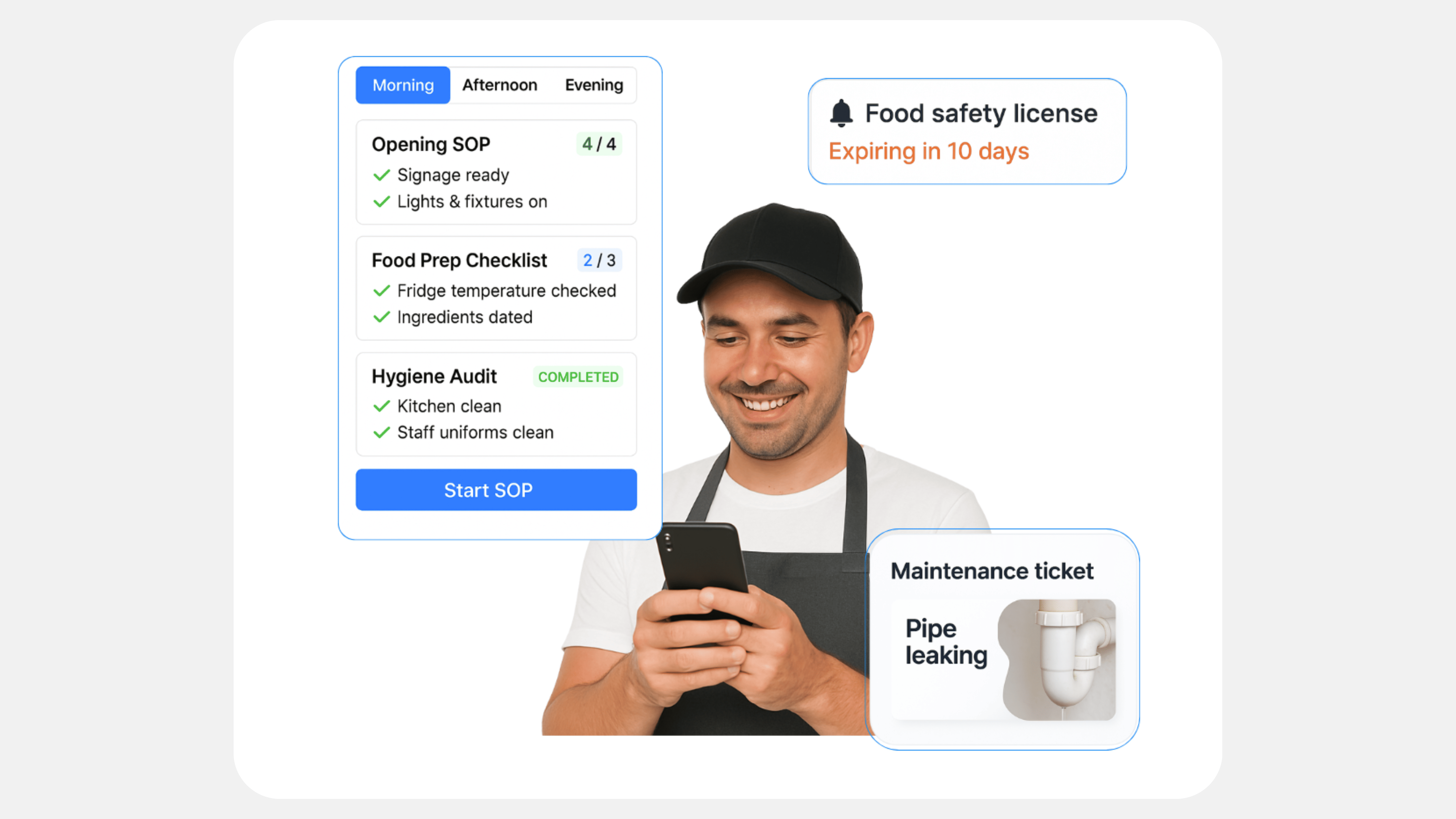
A digital checklist tool for restaurant compliance management makes it easier to standardise this across locations, capture photo evidence, and track completion in real time.
How to Conduct a Restaurant Audit: Step-by-Step
Step 1: Define Scope and Audit Type
Before anything else, be clear on what type of audit this is: internal self-assessment, third-party certification audit, or preparation for a regulatory inspection. Decide whether it covers a single location or multiple sites. Decide whether it will be scheduled or conducted as a surprise. The answers shape everything that follows.
Step 2: Build or Assign Your Checklist
Use a checklist that maps to the FDA Food Code and your state’s health department inspection criteria. If you operate across multiple states, the checklist needs to account for the differences in local requirements. Standardise the checklist across all locations so that scores are comparable and you can identify which sites are consistently underperforming.
Step 3: Conduct the On-Site Inspection
Work through the checklist systematically. Observe real-time behaviour rather than just checking documentation. Are staff actually following handwashing procedures, or does the handwashing log just say they are? Capture photo evidence for all findings, positive and negative. Timestamp everything. Where possible, do not pre-announce the audit to floor staff, as pre-announced audits tend to produce better results than the day-to-day reality.
Step 4: Score and Grade Findings
Not all findings carry the same weight. A useful severity framework has three tiers. Critical findings are those that pose an immediate risk to food safety or public health and could justify immediate closure: improper temperature control on ready-to-eat foods, evidence of pest activity, bare-hand contact with ready-to-eat items. These need same-day corrective action.
Major findings are significant compliance gaps that need to be resolved within 30 days: lapsed certifications, documented allergen protocol failures, missing HACCP records. Minor findings are advisory: equipment showing early signs of wear, minor labelling inconsistencies, housekeeping issues. Scoring findings by severity tier makes it clear where to focus first and provides an objective basis for comparing audit results over time.
Step 5: Document and Distribute the Audit Report
The audit report should include findings by category, photographic evidence, severity scores, overall compliance score, and recommended corrective actions. It should go to the location manager, the area manager, and whoever owns compliance at the organisational level. For third-party audits, the report goes to the commissioning body as well.
Step 6: Assign Corrective Actions with Owners and Deadlines
Every finding needs a named owner, a resolution deadline based on severity tier, and a re-verification date. This is where most audit programmes fail. Findings get documented and reports get filed, but nothing changes because nobody is accountable for fixing anything. Corrective action assignment should happen as part of the audit process, not as a separate follow-up that never quite happens.
Step 7: Monitor, Follow Up, and Re-Audit
Before the next audit cycle, verify that corrective actions were completed. Track recurrence rates across locations and over time. If the same finding keeps coming up at the same location, that is a training problem, not a one-off lapse. Feed persistent findings back into the onboarding and training programme so that systemic issues get addressed at the root.
Audit Frequency: How Often Should You Audit?
Frequency benchmarks vary by restaurant type, risk profile, and whether the audit is internal or third-party.
| Restaurant Type | Internal Audit Frequency | Third-Party Audit |
|---|---|---|
| QSR / Fast Food | Weekly (ops) + Monthly (food safety) | Quarterly |
| Casual / Full Service | Bi-weekly | Semi-annually |
| Multi-Unit Franchise | Bi-weekly per location | Quarterly or per franchisor SLA |
| Ghost Kitchen / Delivery-Only | Weekly | Monthly |
Ghost kitchens and delivery-only operations warrant special mention because they are largely absent from competitor guidance. Without a dining room and front-of-house staff, there is often less visible accountability for kitchen conditions. Food safety and operational audit frequency should be higher for ghost kitchens, not lower, because the physical conditions that customers would normally observe are entirely hidden.
The rule of thumb across all segments: the higher the throughput, the higher the staff turnover, and the more complex the menu, the more frequently you should be auditing.
Common Challenges in Restaurant Compliance Monitoring
Inconsistency Across Locations
When audit processes live on paper or rely on individual managers to interpret standards differently, results drift across shifts and sites. One location’s definition of “clean” is another’s definition of “acceptable.” Standardised digital checklists with photo requirements remove this ambiguity and make results genuinely comparable.
Documentation Gaps
Missing temperature logs, lapsed food handler certifications, incomplete training records: these are the findings that turn a manageable inspection into a serious one. Documentation gaps are rarely deliberate. They happen when compliance processes are not embedded in daily routines and there is no system to flag when records are overdue.
No Post-Audit Accountability
This is the most common reason compliance programmes fail. Audits happen, reports get written, and then nothing changes because findings have no owners and deadlines. Building corrective action assignment directly into the audit workflow, rather than leaving it as a follow-up task, is what separates programmes that improve over time from ones that just generate paperwork.
High Staff Turnover
Restaurant staff turnover is among the highest of any industry. Compliance knowledge that exists in experienced staff walks out the door regularly. Training programmes need to be designed for continuous delivery, with short, frequent reinforcement built into daily operations rather than relying on a single onboarding session that staff forget within weeks.
Multi-Unit Visibility Gap
Area managers overseeing multiple locations often have no real-time view of compliance status across their estate. Without a centralised dashboard, the only way to know what is happening in any given location is to physically be there. Digital compliance monitoring tools solve this problem by aggregating audit results across locations into a single view.
Restaurant Audit Software and Digital Compliance Tools
At three or more locations, paper-based audit processes start to break down. The volume of data, the coordination across sites, and the need for real-time visibility make digital tools the practical choice for any serious restaurant compliance monitoring programme.
When evaluating restaurant audit software, the features that matter most are:
Mobile checklist execution , including offline capability for kitchens where connectivity is unreliable.
Photo and timestamp evidence capture is built into the checklist flow, so documentation happens as part of the audit rather than as a separate step.
Real-time corrective action assignment and tracking , so that findings generate tasks automatically and managers can see what has been resolved and what has not.
Multi-location dashboard with compliance scoring , giving area managers and corporate teams a live view of compliance status across the estate.
Integration with temperature monitoring sensors for automated logging of cooler and freezer data.
Automated audit scheduling and reminders to ensure cadence is maintained without relying on individual managers to remember.
Regulatory standard mapping against HACCP, FDA Food Code, and FSMA requirements so checklists stay aligned with current regulations.
Conclusion
A restaurant audit is not a compliance checkbox. It is the mechanism that keeps food safe, staff protected, and the business operating within the law. Done consistently and with proper follow-through, it is one of the most effective operational tools available to restaurant operators at any scale.
The cost of non-compliance in the US restaurant industry is real: fines, closures, reputational damage, and in the worst cases, serious harm to customers. The brands that avoid those outcomes are not the ones that get lucky. They are the ones that build compliance into how their operations work every day.
Amply — restaurant audit compliance is designed to make that easier. From standardised digital checklists and real-time corrective action tracking to multi-location dashboards and regulatory standard mapping, it gives restaurant operators and franchise groups the tools to run a proper compliance monitoring programme without the administrative overhead.
If you are ready to move compliance off paper and into a system that actually holds people accountable Book a meet to see how Amply works →
Frequently asked questions
What is a restaurant audit? A restaurant audit is a structured review of food safety, operations, compliance, and financial practices, used as a proactive internal or third-party check.
How do you audit a restaurant? Define scope, use a standard checklist, inspect on-site with evidence, score issues, report findings, assign fixes, and verify resolution.
Why do restaurants get audited? To ensure food safety, meet regulations, protect brand standards, and catch issues before they become serious risks.
What does a food safety auditor look for? They check temperatures, hygiene, allergen controls, cross-contamination, sanitation, equipment, certifications, and safety documentation.


